

Upgrading passive speakers is tempting: better drivers, cleaner crossovers, nicer cabinets. The detail that quietly decides whether that upgrade actually works is impedance—the ohm rating printed on the back of the speaker and in your amp’s manual. Ignore it and your new boxes might run quieter than expected, or worse, drag your amp into clipping and thermal protection at the first loud track.
Impedance is just how hard the speaker makes your amplifier work. The trick when upgrading is simple: know what load your amp is happy with, keep the total speaker load within that window, and don’t assume “more expensive” automatically means “same ohms as the old pair.”
According to the technical guide from QSC, running a speaker with an impedance rating lower than your amplifier’s minimum rated load is extremely dangerous, as it causes the amplifier to draw excessive current . This increased current draw forces the amplifier to work far beyond its capacity, leading to rapid overheating and potential, permanent damage to the amplifier’s output stage, even if the volume is kept moderate.1 Therefore, if your amplifier is rated for a minimum of $8\Omega$, you can safely connect $8\Omega$ or $16\Omega$ speakers, but never $4\Omega$ speakers.
What Speaker Impedance Really Is
Impedance is the AC resistance a speaker presents to the amplifier, measured in ohms and varying with frequency; the “4 Ω” or “8 Ω” label is a nominal average, not a fixed value. Lower impedance means the speaker lets more current flow for a given voltage, which can make an amp deliver more power—but also makes it run hotter and work harder.
Most home and small PA amps are rated safe for a certain range per channel—commonly 4–16 Ω or 6–16 Ω. Staying at or above the minimum keeps current draw under control; dropping below it is where you start to risk overheating, shutdowns, or long‑term stress on output devices.
Matching New Speakers to Your Existing Amp
Before buying new passives, read the back panel or manual of your amplifier/receiver and note the minimum speaker impedance per channel. If it says “4–16 Ω” per channel, then any single 4, 6, or 8 ohm speaker on that channel is electrically safe; if it says “6–16 Ω,” you should avoid nominal 4 ohm upgrades on that amp.

When people get in trouble, it’s almost always because they go to a lower impedance than the amp is designed for. A receiver rated for 8 Ω that gets saddled with 4 Ω towers and then run loud can overheat, clip early, or hit protection—exactly the opposite of the “more powerful” feel they were chasing. Going from 8 Ω to 6 Ω on a robust amp is usually fine at sane listening levels, but dropping below its printed minimum and cranking it is asking for trouble.
Multiple Speakers, Series/Parallel, and “Total Load”
If you’re upgrading more than one speaker per channel—say, adding a second pair in another room, or wiring extra surrounds—the total impedance seen by the amp changes with how they’re wired. Two 8 Ω speakers in parallel look like 4 Ω to the amp, while the same pair in series look like 16 Ω. Parallel wiring lowers the load and makes the amp work harder; series wiring raises it and reduces maximum power.
For typical home and small‑venue rigs, the safe rule is: per channel, keep the combined load between about 4 and 16 Ω, and never below the amplifier’s stated minimum. That often means resisting the urge to double up low‑impedance speakers on one output unless the amp is explicitly designed for it.
What Happens If You Get It Wrong
Running speakers with too low an impedance for the amp’s rating increases current draw. The amp runs hotter, may distort earlier, and can trigger protection or, in worst cases, cook output devices and power supply components over time. Using speakers with much higher impedance than the amp expects is safer electrically, but you’ll get less power and headroom; things may simply not play as loud before the amp runs out of usable swing.
You’ll also feel mismatches in sound: reduced dynamic range, earlier compression on peaks, and an amp that sounds strained or dull compared with a properly matched load. If you upgrade speakers and suddenly notice the amp running unusually warm at normal listening levels—or repeatedly tripping protection—double‑check that new impedance against the amp’s spec before blaming the speakers themselves.
Passive Speakers To Go For
5 Core 15″ Subwoofer Speaker – 2000W Full Range PA/DJ, 8 Ohm (FR 15 140 MS)
A 15-inch full-range PA/DJ replacement woofer rated at 250 W RMS / 500 W max / 2000 W peak, designed for use in full-range or sub-heavy PA cabs and DJ speakers. It uses an 8 Ω voice coil, a large 140 × 20 mm ferrite magnet (≈ 60–100 oz class depending on listing), and a 2.5″ CCAW voice coil with an advanced airflow cooling system to handle sustained power without thermal compression. Frequency range is described as full-range with emphasis on deep bass, intended for loud, clear sound in live music, DJ, and pro audio applications.
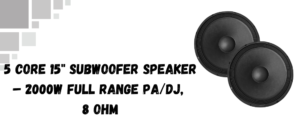
The cone is a cloth-edge paper cone with a specially treated foam/cloth surround for durability and low distortion at high excursion, mounted in a stamped steel frame for straightforward cabinet replacement. Mounting depth is listed around 57–172 mm depending on retailer spec wording, consistent with standard 15″ PA cutouts. This driver is sold as a single raw replacement speaker (no enclosure) for upgrading or repairing passive PA/DJ boxes.
- Type: 15″ full-range/sub PA woofer, raw replacement
- Power handling: 250 W RMS, 500 W max, 2000 W peak
- Impedance: 8 Ω
- Voice coil: 2.5″ CCAW, airflow cooling
- Magnet: 140 × 20 mm ferrite (≈ 60–100 oz class)
- Cone: cloth-edge paper cone, heavy-duty surround
Eminence Delta‑15A – 15″ 400 W, 8 Ohm Woofer (eBay listing 221532308905)
A 15-inch American Standard Series woofer from Eminence, commonly sold under the Delta‑15A model name, designed for professional PA, mid‑bass, and vocal wedge applications in sealed or vented enclosures. It is rated at 400 W RMS / 800 W program at 8 Ω, using an 80 oz ferrite magnet and a 2.5″ aluminum voice coil on a vented core for high power handling and cooling.
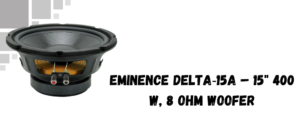
Usable frequency response is typically specified at 48 Hz–4 kHz, with sensitivity around 100–101.6 dB (1 W/1 m), making it significantly more efficient than many generic 15″ woofers. Construction uses a pressed-steel or die-cast basket (model-dependent listing wording), ribbed paper cone with cloth edge, and a solid paper dust cap aimed at robust pro use. The Delta‑15A is widely recommended as a mid‑bass/woofer in PA tops, monitor wedges, and full-range cabs, and the eBay listing 221532308905 matches these core specs.
- Type: 15″ pro audio woofer / mid‑bass
- Power handling: 400 W RMS, 800 W program
- Impedance: 8 Ω
- Magnet: 80 oz ferrite; 2.5″ aluminum voice coil
- Frequency range: ≈ 48 Hz–4 kHz; sensitivity ≈ 100–101.6 dB
Conclusion
When upgrading to new passive speakers, impedance is the quiet compatibility check that keeps your amp and speakers happy together. Match the new speakers’ nominal ohm rating—and the total per‑channel load if you add multiples—to the amplifier’s stated range, avoid going below its minimum, and accept that “safer but a bit less loud” (higher impedance) is always better than “louder on paper but stressing the amp” (too low).
Here you can also find amazing drum thrones; alternatively, browse our product page to find the best keyboard bench, audio mixers, drum mics, piano bench, keyboard stand, speakers, party speakers, and more.