

When you’re chasing maximum bass, it helps to lean on people who live and breathe car audio every day—like the team at Crutchfield. They break it down very simply: sealed enclosures are better if you want tight, accurate, musical low end, while ported boxes are the way to go if you’re after louder, more “boomy” bass and higher output from the same amp power. They also explain how enclosure type, internal volume, and tuning all work together to shape the sub’s character, which is exactly the kind of real-world, tested advice you want to reference before you commit to a box style for your own system
The trick is not chasing the biggest box or the most complicated port; it’s matching the enclosure to your woofer’s specs, your music taste, and the space you’re actually willing to give up in the car.
Sealed vs. Ported: What Kind of Bass Do You Want?
A sealed box is the simple, airtight option. It’s usually smaller, easier to build to spec, and known for bass that feels tight and controlled rather than loose or boomy. The trapped air acts like a spring on the cone, so you get smooth roll‑off and accurate low end at the cost of needing a bit more amplifier power for the same loudness compared with a vented design.
Ported (vented) boxes use a tuned opening to reinforce a specific low‑frequency range. When they’re designed to the right volume and tuning frequency, they’re noticeably louder around that tuned band and can feel more “chesty” and aggressive—perfect if you’re chasing big SPL and chest‑thump in hip‑hop, EDM, or hard rock. The price you pay is size (the box is larger) and a bit of precision; below tuning, the woofer loses control faster, so you have to respect the recommended power and filters.
Box Size and Tuning: Don’t Guess the Volume
However you build it, enclosure volume is not a vibe thing—it’s math. Every woofer has recommended sealed and/or ported volumes from the manufacturer. Stray too small and you choke the low end and increase mechanical stress; go too big or tune too low and the driver can flap around with less control, especially in ported boxes where unloading below tuning can kill a driver in a hurry.
In a real car, you’re balancing that ideal volume against actual trunk or hatch space. Measure the usable area, subtract what you need for amps and daily life, and then see which enclosure alignments still fit. When in doubt, a slightly undersized but correctly sealed box is usually safer than a huge vented experiment with no high‑pass or subsonic filter behind it.
Vehicle, Music, and Everyday Use All Matter
Different vehicles behave like different rooms. Tight hatchbacks and sealed trunks naturally boost some low frequencies, so a sealed 8‑ or 10‑inch sub in the right box can feel surprisingly large. Bigger SUVs and open cabins often benefit from more cone area or ported alignments because the bass has more air to fill.

Your playlist matters too. If you care about fast, articulate kick drums and upright bass lines that stop on a dime, a well‑built sealed box is usually the better partner. If you’re chasing rolling 808s, long bass drops, or sheer “window shake,” a properly tuned vented or down‑firing loaded enclosure is usually more satisfying—especially when you match it with the right amp power and filters.
Product Deep Dive
5 Core 8″ Subwoofer (4-Pack) – 500W Peak Car Audio Bass Replacement Drivers
A set of four 8-inch passive subwoofers designed for bass replacement in custom enclosures or upgrades. Each features 50W RMS / 100W MAX / 500W Peak power handling, 4-ohm impedance, 13oz magnet, 1-inch CCAW voice coil, and steel woofer frame for durability and deep low-end response. Ideal for budget builds needing multiple drivers for distributed bass in trucks/SUVs.

- Size: 8″ woofer
- Power: 50W RMS / 100W MAX / 500W Peak per driver
- Impedance: 4 ohms
- Magnet: 13 oz
- Voice coil: 1″ CCAW
- Frame: Steel basket
- Package: 4x subwoofers
Kicker CompRT Down-Firing 12″ Dual Voice Coil 2-Ohm Loaded Subwoofer Enclosure
A complete vented enclosure with one 12″ CompRT CompC down-firing subwoofer featuring dual 2-ohm voice coils (wireable to 1 or 4 ohms), 400W RMS / 800W Peak power handling, and injection-molded polypropylene cone with 360° back bracing for rugged performance. Ported design tuned for SQ/bass extension; down-firing for space-saving truck/SUV installs. Dimensions: 25.25″W x 14.75″H x 13.25″D.
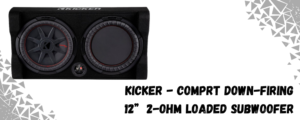
- Size: 12″ down-firing woofer
- Power: 400W RMS / 800W Peak
- Impedance: Dual 2-ohm VC (1/4 ohm wiring)
- Enclosure: Ported vented, black carpeted MDF
- Dimensions: 25.25″ W x 14.75″ H x 13.25″ D
- Mounting depth: 3.75″
The Takeaway
The “perfect” subwoofer box isn’t about copying whatever you saw online—it’s about matching three things: the woofer’s specs, the space you actually have, and the kind of bass you want to live with every day. Sealed for tight and controlled, ported or engineered down‑firing enclosures for more slam and output, and box volume that respects what the driver was built for. Get those pieces in line and even a modest sub can sound huge; ignore them and no amount of wattage will fix a box that’s fighting your bass instead of helping it.
Here you can also find amazing drum thrones; alternatively, browse our product page to find the best keyboard bench, audio mixers, drum mics, piano bench, keyboard stand, speakers, party speakers, and more.